Tuesday, May 19, 2020

First COVID Vaccine Tested on Humans Shows Promise

Inbox
x

WebMD health@messages.webmd.com Unsubscribe

Tue, May 19, 4:09 AM (1 day ago)


to me

Missing image   Missing image   Missing image   Missing image


Trouble viewing this email? View as a Webpage

webmd logo  
Coronavirus Special


First Vaccine Tested on Humans Shows Promise

The first coronavirus vaccine tested on humans has yielded positive results, with a small number of people who were tested showing an immunity against the virus, drugmaker Moderna said. Get the latest news.
Missing Images
Read More  


Home Treatment for Mild COVID-19

Mild COVID-19 still can make you feel lousy. But you should be able to rest at home and recover without a trip to the hospital. Here's how to take care of yourself.
Read More  


Why Do Some Healthy People Get Severe COVID?

The potentially deadly virus seems to spare the relatively young and the generally healthy. But not all of them. The answer could be in their genes.
Read More  


One Dog's Experience With COVID-19

The pug had a cough for a few days, and there was one morning he wouldn't eat breakfast, but it wasn't enough for his family to suspect he had COVID-19.
Read More  


What Makes a Healthy Home Office?

Sitting near a window with natural light will help your mood. What are some other things to do to create a work space that helps keep you healthy?
Watch VIdeo  
In the News

UK Trial Tests Whether Dogs Can Sniff Out Coronavirus


America's Prisons, Jails Are Breeding Grounds for COVID-19

Expert Insights

Ways to Guard Your Mental Health During the Pandemic


What It's Like on the Front Lines of Treating COVID-19


What to Do When Others Aren't Social Distancing


How to Sleep Better With Psoriatic Arthritis

Inbox
x

WebMD health@messages.webmd.com Unsubscribe

Tue, May 19, 10:19 PM (13 hours ago)


to me

Missing image   Missing image   Missing image   Missing image
 
WebMD.com   |  Mobile Apps  |  Unsubscribe  


Trouble viewing this email? View as a Webpage

webmd logo  
Spotlight on Psoriatic Arthritis


How to Sleep Better With Psoriatic Arthritis

Pain, itching, and stress can all keep you from getting the rest you need. Try these things to help ease your symptoms and sleep better.
Missing Images
Read More  


Anatomy of a Flare

How can psoriatic arthritis cause pain in different areas? Take an interactive look at where flare-ups appear and why.
Watch Video  


8 Ways to Ease Your Pain

Psoriatic arthritis comes with the discomfort of two conditions. See what you can do at home to help make your days a lot easier.
Read More  


Things That Can Make Flare-Ups Worse

From bumps and bruises to your diet, keep an eye out for these flare-up triggers.
Read More  


Surprising Complications of Psoriatic Arthritis

The same inflammation that attacks your skin and joints can cause trouble in other parts of your body you might not expect.
Read More  


Make Informed Prescribing Decisions Using Clinical Charts

Inbox
x

MPR editor@email.empr.com Unsubscribe

Tue, May 19, 8:57 PM (14 hours ago)


to me
Use our clinical charts to enhance and ease your learning. These serve as a great reference.
Monthly Prescribing Reference
Hi
Have a look at our clinical charts and provide yourself with a quick and easy reference for treatment strategies.
These tools provide you with information on various disorders and the best ways to approach them.
Dr. Tal Zaks: Likely to be on the market by start of 2021

Moderna’s Israeli top medical officer: We’ve shown today that our vaccine works

US biotech firm’s shares soar as it claims tests of first volunteers show its vaccine candidate produces immune response, ‘has potential to prevent COVID-19’; Phase 3 tests in July

  • In this March 16, 2020, file photo, a pharmacist gives Jennifer Haller, left, the first shot in the first-stage safety study clinical trial of a potential vaccine for COVID-19, the disease caused by the new coronavirus, at the Kaiser Permanente Washington Health Research Institute in Seattle. The vaccine by Cambridge, Massachusetts-based Moderna Inc., generated antibodies similar to those seen in people who have recovered from COVID-19 in a study volunteers who were given either a low or medium dose. (AP Photo/Ted S. Warren, File)
    In this March 16, 2020, file photo, a pharmacist gives Jennifer Haller, left, the first shot in the first-stage safety study clinical trial of a potential vaccine for COVID-19, the disease caused by the new coronavirus, at the Kaiser Permanente Washington Health Research Institute in Seattle. The vaccine by Cambridge, Massachusetts-based Moderna Inc., generated antibodies similar to those seen in people who have recovered from COVID-19 in a study volunteers who were given either a low or medium dose. (AP Photo/Ted S. Warren, File)
  • Moderna's Chief Medical Officer Dr. Tal Zaks. (Channel 12 screenshot)
    Moderna's Chief Medical Officer Dr. Tal Zaks. (Channel 12 screenshot)
  • A sign marks an entrance to a Moderna, Inc., building, Monday, May 18, 2020, in Cambridge, Mass. Moderna announced Monday, May 18, 2020, that an experimental vaccine against the coronavirus showed encouraging results in very early testing, triggering hoped-for immune responses in eight healthy, middle-aged volunteers.(AP Photo/Bill Sikes)
    A sign marks an entrance to a Moderna, Inc., building, Monday, May 18, 2020, in Cambridge, Mass. Moderna announced Monday, May 18, 2020, that an experimental vaccine against the coronavirus showed encouraging results in very early testing, triggering hoped-for immune responses in eight healthy, middle-aged volunteers.(AP Photo/Bill Sikes)
The Israeli chief medical officer of US biotech firm Moderna said Monday that its experimental anti-COVID-19 vaccine “actually works,” after tests on a small number of volunteers, and that it will start Phase 3 testing on thousands of people in July.
“We got the first results today… and today we are showing that it actually works… we are able to stimulate the immune system,” Dr. Tal Zaks said.
In an interview with Israeli television, Zaks said he was confident that, toward the end of the year, “we’ll be able to present first results that prove that our vaccine indeed prevents the disease.”
“By about the end of the year, the start of next year, there’s a reasonable likelihood that we’ll see this vaccine on the market, at least on the American market,” he said in the Channel 12 interview from Moderna’s headquarters in Massachusetts.
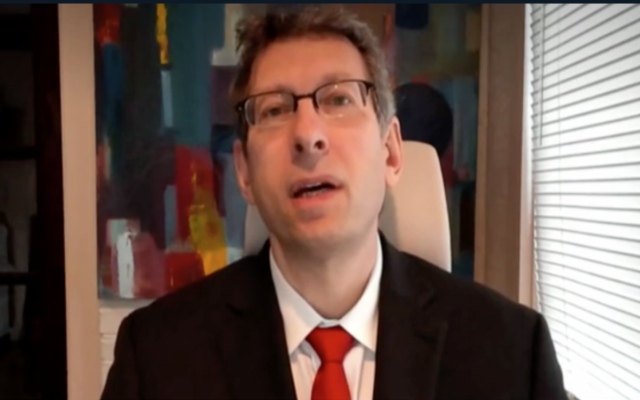
Moderna’s Chief Medical Officer Dr. Tal Zaks. (Channel 12 screenshot)
Zaks said the battle against COVID-19 marked the firm’s ninth bid to develop vaccines against viruses, “and we succeeded with the previous eight.” Thus, he said, “the degree of confidence within the company was always high” that it would succeed this time, too.
News of the company’s progress, revealed in a release earlier Monday, lifted shares of Moderna more than 22 percent, and helped drive the broader stock market higher.

A sign marks an entrance to a Moderna, Inc., building, on May 18, 2020, in Cambridge, Mass. Moderna announced May 18, 2020, that an experimental vaccine against the coronavirus showed encouraging results in very early testing, triggering hoped-for immune responses in eight healthy, middle-aged volunteers. (AP Photo/ Bill Sikes)
The company said the vaccine candidate, mRNA-1273, appeared to produce an immune response in eight people who received it, similar to that seen in people convalescing from the virus.
At the lowest dose, Zaks elaborated in the TV interview, the vaccine candidate produced a similar response to that “naturally” produced by patients who recovered from the virus. At a medium dose, of 100 micrograms, he said, the vaccine candidate created “more antibodies” than those created naturally by recovered patients.
Three groups of 15 patients aged 18 to 55 received three different doses of the vaccine in the Phase 1 test, the complete results of which are not yet known.
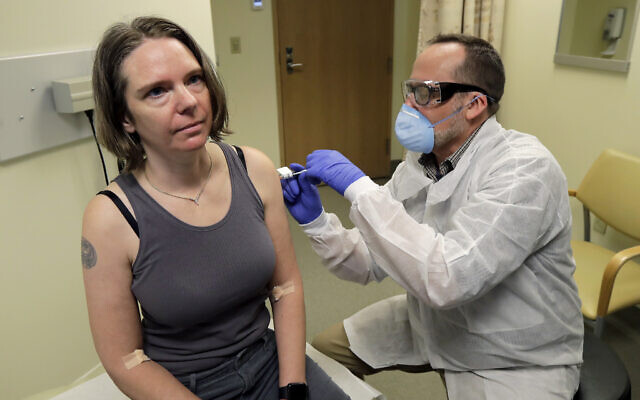
A pharmacist gives Jennifer Haller, left, the first shot in the first-stage safety study clinical trial of a potential vaccine for COVID-19, the disease caused by the new coronavirus, at the Kaiser Permanente Washington Health Research Institute in Seattle, on March 16, 2020. The vaccine by Cambridge, Massachusetts-based Moderna Inc., generated antibodies similar to those seen in people who have recovered from COVID-19 in a study volunteers who were given either a low or medium dose. (AP Photo/Ted S. Warren, File)
The Phase 2 trial, with 600 subjects, has already received the green light from the US Food and Drug Administration and Moderna said they should begin this quarter.
A Phase 3 trial, the largest and most important to validate the efficacy of a vaccine, should begin in July.
“These interim Phase 1 data, while early, demonstrate that vaccination with mRNA-1273 elicits an immune response of the magnitude caused by natural infection,” Zaks stated in the firm’s official release. “These data substantiate our belief that mRNA-1273 has the potential to prevent COVID-19 disease and advance our ability to select a dose for pivotal trials.”
Moderna, which was founded nine years ago, said the vaccine “was generally safe and well tolerated” and that patients suffered no more than redness or soreness from the shots.
In a conference call, Moderna CEO Stephane Bancel said the preliminary tests inspired confidence that mRNA-1273 has “a high probability to provide protection” against the virus.
“We could not be happier about these interim data,” Bancel said of the Phase 1 test, the first of three in the development of a vaccine.
Separate tests performed on mice showed that the vaccine prevented the virus from replicating in their lungs, according to the company.
The US government has invested nearly half a billion dollars in the development of Moderna’s vaccine candidate.
It is being developed in a partnership with the National Institute of Allergy and Infectious Disease headed by Anthony Fauci and the clinical test was carried out by the National Institutes of Health.
“The Moderna team continues to focus on moving as fast as safely possible to start our pivotal Phase 3 study in July,” said Bancel, Moderna’s CEO.
Based on the Phase 1 partial results, Moderna said they would no longer study the highest dose since the lower doses appeared to provide some effect.
“The lower the dose, the more people we expect to be able to protect,” said Moderna president Stephen Hoge.
President Donald Trump has said that he wants 300 million vaccine doses by January 2021 to protect the US population, and his administration has provided funding to Moderna, Johnson & Johnson, and France’s Sanofi.
The development of a vaccine usually takes years but the coronavirus pandemic, which has caused more than 315,000 deaths, has given unprecedented urgency to the search.
A dozen clinical trials are taking place around the world, half of them in China, according to the London School of Hygiene & Tropical Medicine.
China has said that it is carrying out tests on humans of five experimental vaccines.
The challenge is not only finding a safe and efficient vaccine, but also producing billions of doses.
Several large laboratories, including Moderna, have said that they would immediately begin production of an eventual vaccine even before the completion of all of the clinical trials.
Moderna recently announced a partnership with the giant drugmaker Lonza to boost its manufacturing capacity to up to one billion doses a year.
Worldwide, about a dozen vaccine candidates are in the first stages of testing or nearing it. Health officials have said that if all goes well, studies of a potential vaccine might wrap up by very late this year or early next year.
More than 4.7 million infections and 315,000 deaths from the coronavirus have been confirmed worldwide since it emerged in China late last year. There are no specific approved treatments, although several are being used on an emergency basis after showing some promise in preliminary testing.
Race to ready drug for potential winter outbreak

Scientists in China believe new drug can stop pandemic ‘without vaccine’

Antibodies isolated from the blood of 60 recovered patients key to treatment that shortens recovery time, offers short-term immunity in mice

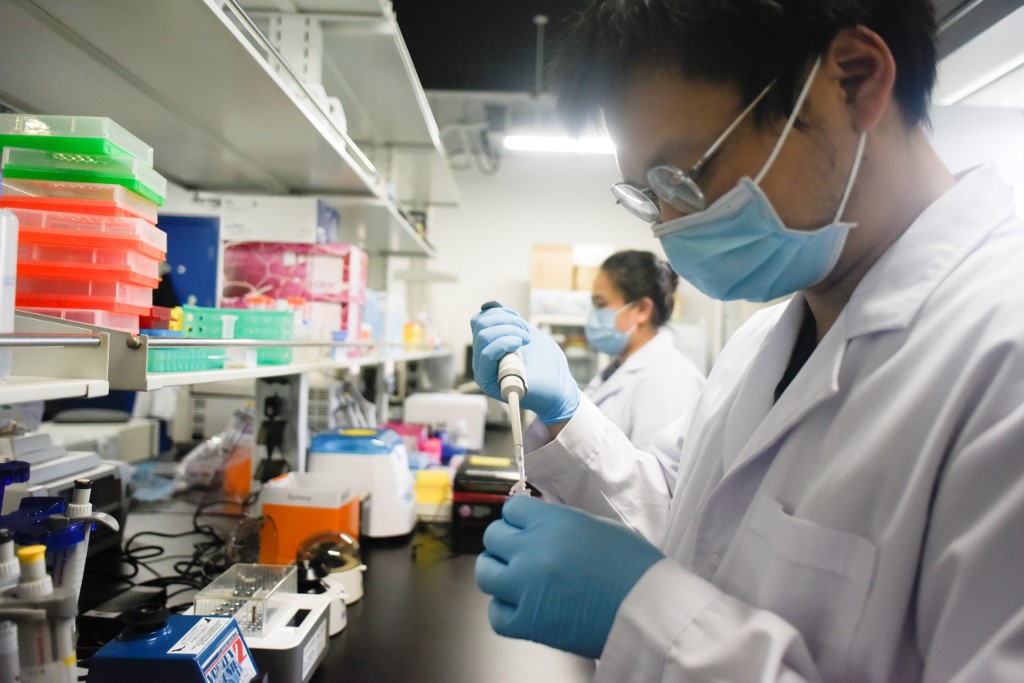
This picture taken on May 14, 2020, shows researchers at Peking University's Beijing Advanced Innovation Center for Genomics conducting tests at their laboratory in Beijing. (Wang Zhao/AFP)
BEIJING, China (AFP) — A Chinese laboratory has been developing a drug it believes has the power to bring the coronavirus pandemic to a halt.
The outbreak first emerged in China late last year before spreading across the world, prompting an international race to find treatments and vaccines.
A drug being tested by scientists at China’s prestigious Peking University could not only shorten the recovery time for those infected, but even offer short-term immunity from the virus, researchers say.
Sunney Xie, director of the university’s Beijing Advanced Innovation Center for Genomics, told AFP that the drug has been successful at the animal testing stage.
“When we injected neutralizing antibodies into infected mice, after five days the viral load was reduced by a factor of 2,500,” said Xie.
This picture taken on May 14, 2020, shows Sunney Xie, director of Peking University’s Beijing Advanced Innovation Center for Genomics, during an interview at his laboratory in Beijing. (Wang Zhao/AFP)
“That means this potential drug has (a) therapeutic effect.”
The drug uses neutralizing antibodies — produced by the human immune system to prevent the virus infecting cells — which Xie’s team isolated from the blood of 60 recovered patients.
A study on the team’s research, published Sunday in the scientific journal Cell, suggests that using the antibodies provides a potential “cure” for the disease and shortens recovery time.
Xie said his team had been working “day and night” searching for the antibody.
“Our expertise is single-cell genomics rather than immunology or virology. When we realized that the single-cell genomic approach can effectively find the neutralizing antibody we were thrilled.”
He said he hopes that the drug will be ready for use later this year and in time for any potential winter outbreak of the virus, which has infected 4.8 million people around the world and killed more than 315,000.
A medical worker takes a swab sample from a woman to be tested for the COVID-19 coronavirus in Wuhan, in China’s central Hubei province on May 19, 2020. (Hector Retamal/AFP)
“Planning for the clinical trial is underway,” said Xie, adding it will be carried out in Australia and other countries since cases have dwindled in China, offering fewer human subjects for testing.
“The hope is these neutralizing antibodies can become a specialized drug that would stop the pandemic,” he said.
China already has five potential coronavirus vaccines at the human trial stage, a health official said last week.
But the World Health Organization has warned that developing a vaccine could take 12 to 18 months.
Scientists have also pointed to the potential benefits of plasma — a blood fluid — from recovered individuals who have developed antibodies to the virus enabling the body’s defenses to attack it.
Pedestrians wearing face masks walk along a business street in Beijing on May 19, 2020. (Wang Zhao/AFP)
More than 700 patients have received plasma therapy in China, a process which authorities said showed “very good therapeutic effects.”
“However, it (plasma) is limited in supply,” Xie said, noting that the 14 neutralizing antibodies used in their drug could be put into mass production quickly.

Prevention and cure

Using antibodies in drug treatments is not a new approach, and it has been successful in treating several other viruses such as HIV, Ebola and Middle East Respiratory Syndrome (MERS).
Xie said his researchers had “an early start” since the outbreak started in China before spreading to other countries.
Ebola drug Remdesivir was considered a hopeful early treatment for COVID-19 — clinical trials in the US showed it shortened the recovery time in some patients by a third — but the difference in mortality rate was not significant.
This picture taken on May 14, 2020 shows a researcher at Peking University’s Beijing Advanced Innovation Center for Genomics conducting tests at their laboratory in Beijing. (Wang Zhao/AFP)
The new drug could even offer short-term protection against the virus.
The study showed that if the neutralizing antibody was injected before the mice were infected with the virus, the mice stayed free of infection and no virus was detected.
This may offer temporary protection for medical workers for a few weeks, which Xie said they are hoping to “extend to a few months.”
More than 100 vaccines for COVID-19 are in the works globally, but as the process of vaccine development is more demanding, Xie is hoping that the new drug could be a faster and more efficient way to stop the global march of the coronavirus.
“We would be able to stop the pandemic with an effective drug, even without a vaccine,” he said.