medical news from internet

Friday, May 29, 2020

How countries are using genomics to help avoid a second coronavirus wave
Scientists in New Zealand, the United Kingdom and other places are using sequence data to track new infections as lockdowns ease.

Clare Watson


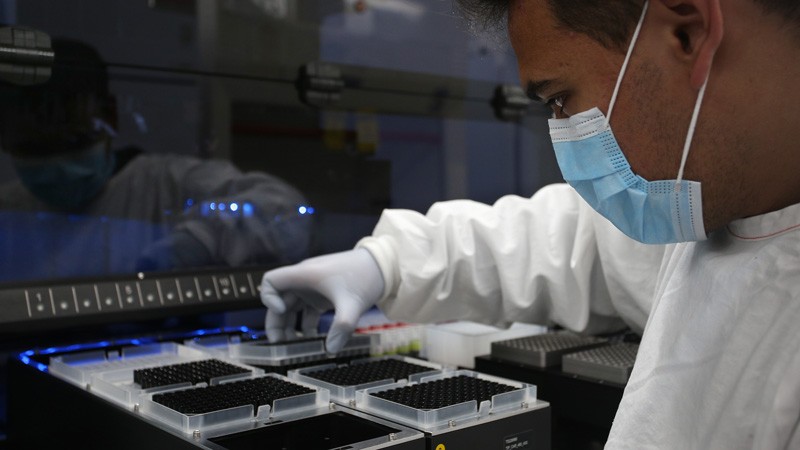
NSW Health Pathology Randwick Lab At Forefront Of COVID-19 Testing In Australia.
Credit: Lisa Maree Williams/Getty
As many countries emerge from lockdowns, researchers are poised to use genome sequencing to avoid an expected second wave of COVID-19 infections.
Since the first whole-genome sequence of the new coronavirus, SARS-CoV-2, was shared online on 11 January, scientists have sequenced and shared some 32,000 viral genomes from around the world. Such a vast amount of data has allowed researchers to trace the origin of COVID-19 outbreaks in their countries and pinpoint when community transmission occurred1.
Now, countries that have successfully suppressed infections are entering the next phase of the COVID-19 pandemic — where there's a risk of new cases appearing as social restrictions ease. Researchers say that genomics will be crucial to quickly track and control these outbreaks. Studies already show that outbreaks tend to be shorter and smaller when genomics is used to help contact tracing2.
“When there are few cases, genomics can very quickly tell you what you’'re dealing with and therefore guide precision interventions,” says Gytis Dudas, a consulting bioinformatician at the Gothenburg Global Biodiversity Centre in Sweden.

Coronavirus and COVID-19: Keep up to date

Several places are particularly well placed to do that because they invested in genome sequencing early in the pandemic and have a relatively small numbers of cases. Researchers in New Zealand, and at least one state in Australia decided that they would aim to sequence most coronavirus genomes in their country or state.
As SARS-CoV-2 spread around the world, distinct lineages began to form as viruses circulating in different regions gradually evolved. By comparing sequences, researchers can quickly rule out possible lines of transmission if two sequences don’t match, or link together cases that do.
Scientists in the United Kingdom, the United States and other countries are also sequencing SARS-CoV-2 from a large proportion of cases there, but because their epidemics are still ongoing and case numbers are high, genomics is being used to monitor spread and help identify the source of some cases where contact tracing fails. But such interventions depend on broad sampling, and so in places where diagnostic testing is limited, there will also be gaps in the genomic data.

Fast off the mark

Before the first reported case arrived in Australia from Wuhan, China, on 19 January3, researchers at a laboratory in Melbourne that usually investigates outbreaks of food-borne illness started preparing to sequence SARS-CoV-2 genomes in the state of Victoria.
“We said, let’s just sequence every positive case we get,” says Torsten Seemann, a bioinformatician at the Microbiological Diagnostic Unit Public Health Laboratory based at the Peter Doherty Institute for Infection and Immunity in Melbourne.
So far, Seemann’s team has sequenced three-quarters of the state’s roughly 1,700 cases4, thought to be the most comprehensive sequencing coverage in the world for an infectious-disease outbreak. By comparison, researchers working on the 2014–16 West Africa Ebola epidemic sequenced 5% (1,610 samples) of all infected cases5 in just under 3 years.

The race for coronavirus vaccines: a graphical guide

The sequence data has helped resolve the true source of exposure for a health-care worker, proving that they contracted the virus at a social event and not from a patient in hospital. “Without genomics, and only interviewing, you would never be able to tell which one it was,” Seemann says. The information prevented the need for an investigation into a possible outbreak at the hospital, he says.

Borders reopen

Seemann’s team is preparing to use genomic data to help identify the probable origin of new cases that arise as Victoria’s social restrictions ease. Public-health officials will be able to make decisions to control outbreaks much faster than was possible in the first few weeks of the pandemic when there were fewer genomes to compare, he says.
The genomic data will be particularly important when regional travel resumes. Borders for all states in Australia have been closed since March, but new infections are expected when they reopen. Over the past two months, viral genomes will have mutated just enough to tell whether they come from outside the state, researchers say. “As soon as we get the sequence, we’ll be able to tell whether it came across the border or not,” Seemann says.
Scientists in New Zealand have so far sequenced 25% of country’s 1,154 reported cases. They’re aiming for more than 70% to get the most complete picture practically possible, says Joep de Ligt, lead bioinformatician at New Zealand’s Institute of Environmental Science and Research near Wellington, which is sequencing the country's cases. With every sequence added, researchers are more likely to be able to pinpoint where the next case fits.
But the sequence data is already proving useful in responding to outbreaks, he says. Genomic data have identified links between cases that were missed by traditional contact tracing and have untangled two clusters that were thought to be one.

Community spread

In the United Kingdom, with vastly more cases, the COVID-19 Genomics UK Consortium, which includes research centres and university labs, formed in March. It has so far sequenced 20,000 viral genomes, representing nearly 10% of lab-confirmed cases in the country, says Nick Loman, a bioinformatician at the University of Birmingham who is part of the consortium. He was one of the team that pioneered rapid genomic-surveillance tools during the Ebola outbreak, which are now being used during the COVID-19 pandemic.
The team hasn’t set a target like New Zealand, says Loman, partly because the United Kingdom has so many cases — approaching 265,000 confirmed infections as of 27 May. Instead, they’re aiming to generate a representative sample of sequences from across the United Kingdom that can support epidemiological investigations.

‘Slips through the cracks’

But using genomics as part of the response to an outbreak has limitations, says de Ligt. With SARS-CoV-2, people who experience asymptomatic infections are unlikely to get tested, he says. “There is that real risk that something slips through the cracks.”
Genomic surveillance also relies on widespread diagnostic testing to capture sequences in the first place, says Loman. The United Kingdom was inundated with cases and was slow to ramp up diagnostic testing. “There’s always the possibility that you’ve not sampled some cases,” he says.
Loman notes that global genomic surveillance will be important when international travel resumes.
But the use of genomic analysis to help contact tracing is largely restricted to high-income countries, says Meru Sheel, an epidemiologist at the Australian National University in Canberra. She would like to see genomics considered as a tool for outbreak responses in resource-limited countries in the Asia–Pacific region, as it was in the Democratic Republic of the Congo, Sierra Leone and Guinea during the Ebola outbreak.
doi: 10.1038/d41586-020-01573-5

References

  1. 1.
    Zhang, Y.-Z. & Holmes, E. C. Cell 181, 223–227 (2020).
      • PubMed
      • Article
      • Google Scholar
  2. 2.
    Stevens, E. et al. Front. Microbiol. 8, 808 (2017).
      • PubMed
      • Article
      • Google Scholar
  3. 3.
    Caly, L. et al. Med. J. Aust. https://doi.org/10.5694/mja2.50569 (2020).
      • PubMed
      • Article
      • Google Scholar
  4. 4.
    Seemann, T. et al. Preprint available at MedRxiv https://doi.org/10.1101/2020.05.12.20099929 (2020).

  5. 5.
    Dudas, G. et al. Nature 544, 309–315 (2017).
      • PubMed
      • Article
      • Google Scholar
Download references

Nature Briefing

An essential round-up of science news, opinion and analysis, delivered to your inbox every weekday.

Related Articles

  • Coronavirus and COVID-19: Keep up to date Coronavirus and COVID-19: Keep up to date

  • Mystery deepens over animal source of coronavirus Mystery deepens over animal source of coronavirus

  • How do children spread the coronavirus? The science still isn’t clear How do children spread the coronavirus? The science still isn’t clear

  • Coronavirus vaccine trials have delivered their first results — but their promise is still unclear Coronavirus vaccine trials have delivered their first results — but their promise is still unclear

  • Animal source of the coronavirus continues to elude scientists Animal source of the coronavirus continues to elude scientists

Sign up for the Nature Briefing newsletter for a daily update on COVID-19 science.

  • Posted by Bamr Mann bombaymann@gmail.com at 11:12 PM No comments:
    Email ThisBlogThis!Share to XShare to FacebookShare to Pinterest

    Head of Pfizer pharmaceuticals says vaccine could be ready by October
    By NIna Larson
    With over 100 labs scrambling to develop COVID-19 vaccination, pharma executives hopeful for roll out before 2021, but cite ‘daunting’ challenges in producing billions of doses


    Head of Pfizer pharmaceuticals says vaccine could be ready by October

    With over 100 labs scrambling to develop COVID-19 vaccination, pharma executives hopeful for roll out before 2021, but cite ‘daunting’ challenges in producing billions of doses

    By NIna Larson Today, 1:38 am 5

    • 18,755 shares
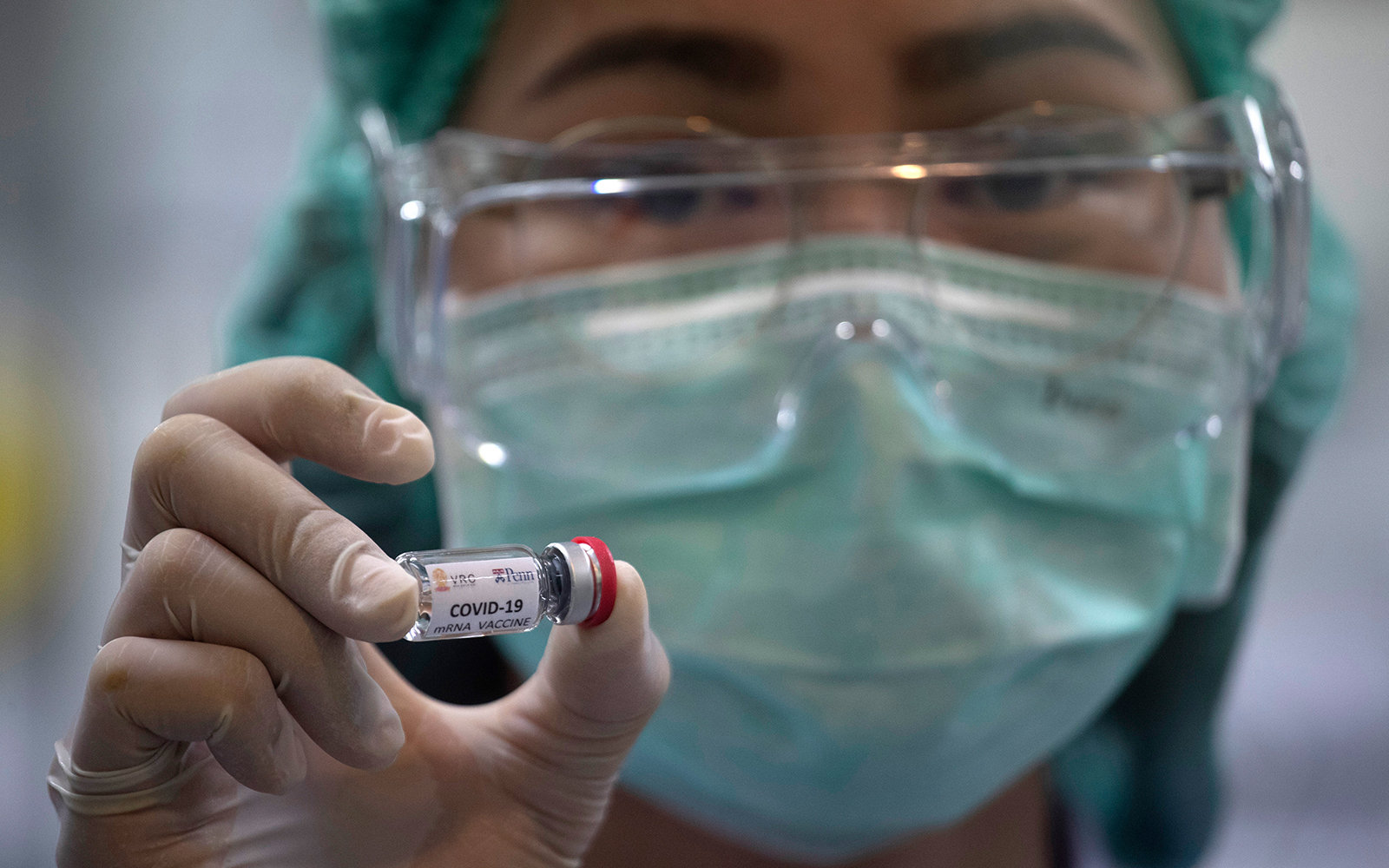
    A lab technician holds a vial containing results for COVID-19 vaccine testing at the National Primate Research Center in Saraburi Province, north of Bangkok, Thailand, May 23, 2020. (AP/Sakchai Lalit)
    A lab technician holds a vial containing results for COVID-19 vaccine testing at the National Primate Research Center in Saraburi Province, north of Bangkok, Thailand, May 23, 2020. (AP/Sakchai Lalit)
    AFP — Pharmaceutical company executives said Thursday that one or several COVID-19 vaccines could begin rolling out before 2021, but warned the challenges would be “daunting” as it was estimated that 15 billion doses would be needed to halt the pandemic.
    Well over 100 labs around the world are scrambling to come up with a vaccine against the novel coronavirus, including 10 that have made it to the clinical trial stage.
    Albert Bourla, head of Pfizer, said that his company believed a vaccine could be ready before the end of the year. Pfizer is conducting clinical trials with German firm Biontech on several possible vaccines in Europe and the United States.

    “If things go well, and the stars are aligned, we will have enough evidence of safety and efficacy so that we can… have a vaccine around the end of October,” he said.
    Albert Bourla, DVM, Ph.D. Chief Executive Officer Pfizer, prepares to testify before a Senate Finance Committee hearing on drug prices, Feb. 26, 2019 on Capitol Hill in Washington. (AP Photo/Pablo Martinez Monsivais)
    “The hope of many people is that we will have a vaccine, hopefully several, by the end of this year,” Pascal Soriot, head of AstraZeneca, told a virtual briefing.
    His company is partnering with the University of Oxford to develop and distribute a vaccine being trialed in Britain.
    It can take years for a new vaccine to be licensed for general use, but in the face of the COVID-19 pandemic, experimental vaccines shown to be safe and effective against the novel coronavirus could likely win approval for emergency use.
    The International Federation of Pharmaceutical Manufacturers and Associations (IFPMA), which organized Thursday’s briefing, highlighted the “daunting” challenges facing the industry in the push for a vaccine.
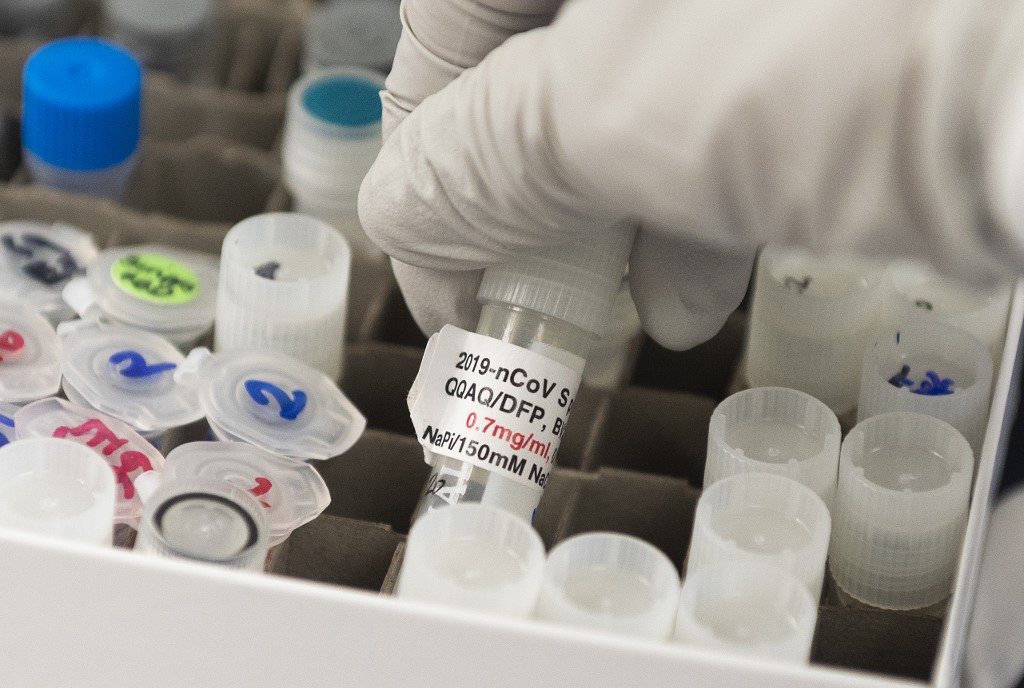
    Dr. Nita Patel, director of antibody discovery and vaccine development, lifts a vial with a potential coronavirus, COVID-19, vaccine at Novavax labs in Rockville, Maryland on March 20, 2020 (ANDREW CABALLERO-REYNOLDS / AFP)
    One challenge, which may seem counterintuitive, is that transmission rates are rapidly declining in Europe where some of the trials are taking place.
    Soon they will be too low to properly conduct clinical vaccine trials in a natural setting, Soriot said, adding that so-called “human challenge” studies in which people are intentionally exposed to the virus to test efficacy, were not considered ethically acceptable with COVID-19.
    “We are running against time,” he said.
    The novel coronavirus has killed more than 358,000 people and infected at least 5.7 million worldwide in a matter of months.
    IFPMA director Thomas Cueni pointed to estimates that the world will need some 15 billion doses to stop the virus, posing massive logistical challenges.
    He stressed that the industry was committed to ensuring equitable access to a future vaccine, but acknowledged that “we will not have sufficient quantities as from day one, even with the best efforts.”
    Once a working vaccine is developed, one of the biggest obstacles to putting out the amount needed could be, surprisingly, that there are not enough glass vials to store the doses in.
    “There are not enough vials in the world,” Soriot said, adding that AstraZeneca, like a number of other firms, was looking into the possibility of putting multiple doses in each vial.
    Paul Stoffels, vice chairman and chief scientific officer at Johnson and Johnson, meanwhile said that if 15 billion doses were needed, a number of different vaccines would be necessary to satisfy the initial demand.
    “Not all vaccine candidates could go all over the world depending on features, so somewhere between five and 10 will definitely be needed to serve the whole world,” he said.
    One challenge could be that some of the vaccines being worked on require storage at very low temperatures, which could be difficult in places lacking the proper infrastructure.
    While stressing the need for solidarity and for ensuring fair and equitable distribution of a COVID-19 vaccine, the pharmaceutical chiefs flatly rejected any suggestion that intellectual property rights should be waived on vaccine research.
    “IP is absolutely fundamental to our industry,” GSK chief Emma Walmsley said.
    Soriot meanwhile pointed out that pharmaceutical companies are currently investing billions of dollars with little chance of recuperating the costs.
    “If you don’t protect IP, then essentially there is no incentive for anybody to innovate,” he said.
    Posted by Bamr Mann bombaymann@gmail.com at 9:10 AM No comments:
    Email ThisBlogThis!Share to XShare to FacebookShare to Pinterest
    News

    Microsoft India Backs IIT Delhi Covid-19 Tech Solutions

    Kritti Bhalla
    Inc42 Staff
    29 May'20 2 min read
    Share story
    Under this, Microsoft India will offer both financial and technological support
    IIT Delhi will use the fund for commercialisation and further research
    Meanwhile, several Indian investors are also offering financial assistance to such initiatives through ACT grant
    Microsoft India Offers Supports To Two IIT Delhi Covid-19 Tech Solutions
    Microsoft India is offering financial and technology support, in the form of resource and infrastructure, to two Covid-19 solutions developed by the Indian Institute of Technology (IIT) Delhi.
    Prof. V Ramgopal Rao, director of IIT Delhi, said, “Microsoft India has time and again associated with IIT-Delhi for the betterment of research, and this contribution to projects focused on COVID-19 detection research shall help the nation combat these difficult times. Timely detection can prove to be the key to curb the spread of the virus, and I am glad our institute is devising means to achieve it.”
    Rohini Srivathsa, national technology officer of Microsoft India said that researchers at IIT Delhi are leading critical efforts to develop low-cost diagnostic solutions that will make Covid-19 testing affordable and accessible for all.

    Probe-Free RT-PCR

    The Kusuma School of Biological Sciences at IIT Delhi has developed a probe-free reverse transcription-polymerase chain reaction (RT-PCR)-based Covid-19 detection assay. RT-PCR is a nuclear-derived method of detecting the presence of specific genetic material including a virus.
    The probe-free technology is said to be more affordable and easily scalable. It has also been approved by Indian Council of Medical Research (ICMR), the apex biomedical body.

    ELISA-Based Diagnostic Serological Assay

    IIT Delhi, in collaboration with the National Chemical Laboratory in Pune, is looking to develop an enzyme-linked immunosorbent assay (ELISA)-based diagnostic serological assay to fight Covid-19.
    If successful, it will create an economical and commercial process for manufacturing the antigens used in ELISA. Moreover, it will also offer home-based diagnostic kits to offer an effective, quick, robust and affordable diagnostic solution to the outbreak.
    Professor Anurag Rathore, Dean of Corporate Relations at IIT Delhi also added that the grant from Microsoft India will aid in the commercialisation of the probe-free detection and also funds research on examining the possibility of creating an ELISA like assay for Covid-19 detection.
    Meanwhile, even big investment firms have set up a INR 100 Cr Action Covid-19 Team (ACT) grant to help ideas, initiatives and startups looking to combat the virus. Lightspeed, Kalaari, SAIF Partners, India Quotient, Sequoia, Matrix, Omidyar Network India, Nexus, Accel, Chiratae, and Blume Ventures had extended their support to ACT. The grant has backed companies and projects like MolBio Diagnostics, Mylab Discovery Solutions and Project PCR Sample Pooling that are developing cost-effective solutions for Covid-19 testing.
    Coronavirus Microsoft Technology
    Note: We at Inc42 take our ethics very seriously. More information about it can be found here.
    Posted by Bamr Mann bombaymann@gmail.com at 9:01 AM No comments:
    Email ThisBlogThis!Share to XShare to FacebookShare to Pinterest

    Coronavirus Update: Airborne Transmission Likely, Expert Says

    Inbox
    x

    WebMD <health@messages.webmd.com> Unsubscribe

    4:03 AM (17 hours ago)


    to me


    Aerosol Scientist: COVID-19 Is Likely Airborne

    Airborne transmission means that people could possibly catch COVID-19 by breathing it in, this scientist says. That means 6 feet is not far enough to stand apart, and we should probably be wearing masks a lot more often.
    Missing Images
    Read More  

    'Silent' COVID-19 More Widespread Than We Thought

    More than 80% of those who tested positive for the coronavirus had no symptoms, according to a new study of cruise ship passengers.
    Read More  


    Get to Know Your Lungs

    Diseases like COVID-19, which can attack the lungs, shine a light on how important these organs are. Find out what you can do to keep them healthy.
    Read More  


    Are We Ready for the Next Wave?

    Are we prepared for a possible second wave of infections in the fall? Hear what an expert in emergency preparedness has to say.
    Watch Video  


    Expert: Outdoor Pools Not a Risk

    Swimming pools in many parts of the U.S. may reopen soon, and Americans can take comfort in knowing that taking a dip should pose little risk of coronavirus infection.
    Read More  


    Is the Pandemic Revealing Your True Friends?

    You might find that you're getting more support from some friends than others during the coronavirus pandemic.
    Read More  


    How to Manage Anxiety About Reopening

    With reopening come many questions about whether we're doing the right thing and if we're being careful enough.
    Read More  
    In the News

    News Roundup: Get the Latest Coronavirus Headlines


    Half of Americans Say They'd Get COVID-19 Vaccine


    Phased Disney World Reopening Starting July 11

    Healthy at Home

    What's for Dinner? Try Our Recipe Finder Tool


    Could Fasting Help You Lose the Extra Lockdown Weight?


    Ways to Improve Your Walking Technique


    Trouble viewing this email? View as a Webpage

    webmd logo  
    Coronavirus Special


    Posted by Bamr Mann bombaymann@gmail.com at 8:58 AM No comments:
    Email ThisBlogThis!Share to XShare to FacebookShare to Pinterest
    Newer Posts Older Posts Home
    Subscribe to: Comments (Atom)

    About Me

    Bamr Mann bombaymann@gmail.com
    View my complete profile

    Blog Archive

    • ▼  2026 (61)
      • ▼  February (61)
        •  3.6.2. Aspirin and SARS-CoV-2 InfectionThe global...
        • HIV Overview HIV Prevention HIV Treatment Drug Res...
        • Apr 20 Grok 3 Just Predicted When We’ll Achieve Su...
        • @globalnewsdiscs ARTIFICIAL SUPERINTELLIGENCE@GEOS...
        • See new posts Conversation . @globalnewsdiscs Trea...
        • . @globalnewsdiscs how to control super intelligen...
        • . @globalnewsdiscs 3 METHODS FOR KIDNEY REGENERAT...
        • . @globalnewsdiscs Comprehensive Strategy to Annih...
        • See new posts Conversation . @globalnewsdiscs rein...
        • @globalnewsdiscs Visionary Novel Technologies FOR ...
        • @globalnewsdiscs CANCER CONTROL@2030-CHAT APR 23-W...
        • @globalnewsdiscs CANCER TREATMENT AND quantum mult...
        • @globalnewsdiscs Magnets in Cancer Control: https:...
        • See new posts Conversation . @globalnewsdiscs Cybo...
        • . @globalnewsdiscs Nanobot Mechanics Role in Biolo...
        • key milestones for Alzheimer’s treatment advanceme...
        • . @globalnewsdiscs Countermeasures-to prevent a fu...
        • . @globalnewsdiscs AI==CHATGPT=-ON COOLING HOME WI...
        • See new posts Conversation . @globalnewsdiscs NEUR...
        • @globalnewsdiscs AI -GROK3-CHAT ON "ALZIEHMER DISE...
        • . @globalnewsdiscs NEURALINK(non invasive=BCI)PROB...
        • @globalnewsdiscs AUTISM-TREATMENT - @GROK3 https:...
        • @globalnewsdiscs chat with AI GROK3-Objective: Acc...
        • @globalnewsdiscs chat with GROK:-CRISPR base editi...
        • @globalnewsdiscs GROK3 MAY 24-11.14 AM CHAT ON EXO...
        • @globalnewsdiscs GROK3 CHAT MAY 24-11.30AM TO 4.26...
        • See new posts Conversation . @globalnewsdiscs chat...
        • . @globalnewsdiscs DARK CHOCOLATE -WITHOUT SUGAR -...
        • . @globalnewsdiscs FUTURE{Grok's chat,no:3}emergen...
        • . @globalnewsdiscs CHAT GPT DISCUSSION -“Recogniti...
        • . @globalnewsdiscs a revolutionary method that tri...
        • . @globalnewsdiscs GROKchat2-CANCER-quantum profil...
        • @globalnewsdiscs DISCUSSION WITH AI-GROK ON WEIGHT...
        • See new posts Conversation . @globalnewsdiscs a fu...
        • . @globalnewsdiscs ASTHMA -alternate treatment if ...
        • @globalnewsdiscs GROK-DISCUSSION ON USING SATELLIT...
        • @globalnewsdiscs sugar cane[ GMO]WITH NO SUGAR&NO ...
        • @globalnewsdiscs CHAT WITH GROK- AR glasses that g...
        • @globalnewsdiscs : “Revolutionizing Beauty: Protot...
        • @globalnewsdiscs CRISPER CUT FOR HIV CURE-AND POSS...
        • @globalnewsdiscs CRISPER CUT FOR HIV CURE-AND POSS...
        • See new posts Conversation . @globalnewsdiscs chat...
        • . @globalnewsdiscs GROK3 ON-Autism isn't just one ...
        • @globalnewsdiscs Chat with GROK3 0N USING SEA CUCU...
        • . @globalnewsdiscs 2040 Vision: The 'Holographic D...
        • . @globalnewsdiscs CHAT-CONTINUATION ON CANCER WIT...
        • . @globalnewsdiscs chat on genes and cancer with g...
        • . @globalnewsdiscs AI and online controlled emerge...
        • @globalnewsdiscs Paralysed woman able to ‘speak’ t...
        • . @globalnewsdiscs chat with GROK-:-whose haptic i...
        • @globalnewsdiscs 2-latest method to control blood ...
        • See new posts Conversation . @globalnewsdiscs CHAT...
        • @globalnewsdiscs GROK-on pollution control using v...
        • . @globalnewsdiscs Chat@Grok,Security+peepTech,sun...
        • @globalnewsdiscs GROK ON BEAUTY https://pazhayathu...
        • @globalnewsdiscs Grok on pollutoncontrol -with-mic...
        • . @globalnewsdiscs Grok's Plan for Reversing Popul...
        • @globalnewsdiscs 2040 Vision: The 'Holographic Doc...
        • . @globalnewsdiscs CHAT-CONTINUATION ON CANCER WIT...
        • chat on genes and cancer with grok https://pazhaya...
        • AI-GROK- Understanding Lymphoma
    • ►  2025 (26)
      • ►  September (1)
      • ►  August (2)
      • ►  June (2)
      • ►  May (15)
      • ►  April (1)
      • ►  March (4)
      • ►  January (1)
    • ►  2024 (30)
      • ►  December (5)
      • ►  November (2)
      • ►  September (2)
      • ►  August (3)
      • ►  May (9)
      • ►  April (3)
      • ►  March (2)
      • ►  February (1)
      • ►  January (3)
    • ►  2023 (16)
      • ►  October (2)
      • ►  September (2)
      • ►  June (1)
      • ►  April (1)
      • ►  March (1)
      • ►  February (7)
      • ►  January (2)
    • ►  2022 (9)
      • ►  November (2)
      • ►  October (1)
      • ►  September (1)
      • ►  February (1)
      • ►  January (4)
    • ►  2021 (28)
      • ►  December (5)
      • ►  November (3)
      • ►  October (2)
      • ►  September (3)
      • ►  July (1)
      • ►  June (1)
      • ►  May (3)
      • ►  April (3)
      • ►  March (3)
      • ►  January (4)
    • ►  2020 (330)
      • ►  December (2)
      • ►  November (1)
      • ►  September (1)
      • ►  August (2)
      • ►  July (14)
      • ►  June (60)
      • ►  May (134)
      • ►  April (81)
      • ►  March (24)
      • ►  February (3)
      • ►  January (8)
    • ►  2019 (45)
      • ►  December (3)
      • ►  November (1)
      • ►  September (1)
      • ►  July (2)
      • ►  June (4)
      • ►  May (9)
      • ►  April (10)
      • ►  March (2)
      • ►  February (6)
      • ►  January (7)
    • ►  2018 (58)
      • ►  December (16)
      • ►  November (15)
      • ►  October (1)
      • ►  September (4)
      • ►  August (1)
      • ►  July (1)
      • ►  June (7)
      • ►  May (3)
      • ►  April (3)
      • ►  March (2)
      • ►  February (2)
      • ►  January (3)
    • ►  2017 (63)
      • ►  December (8)
      • ►  October (8)
      • ►  September (3)
      • ►  July (1)
      • ►  June (7)
      • ►  April (9)
      • ►  March (4)
      • ►  February (11)
      • ►  January (12)
    • ►  2016 (83)
      • ►  December (5)
      • ►  November (8)
      • ►  October (7)
      • ►  September (4)
      • ►  August (15)
      • ►  July (8)
      • ►  June (3)
      • ►  May (3)
      • ►  April (11)
      • ►  March (4)
      • ►  February (6)
      • ►  January (9)
    • ►  2015 (50)
      • ►  December (13)
      • ►  November (9)
      • ►  October (22)
      • ►  September (6)
    Simple theme. Powered by Blogger.