| |||||
|
|||||
Hello Nature readers,
Today we learn that the Universe’s coolest lab has created bizarre quantum matter in space, explore how healthy blood vessels might protect children from serious effects of COVID-19 and go on the hunt for the microbial ‘dark matter’ that has never been cultured in the lab. |
|||||

|
|||||
| The International Space Station is home to the Cold Atom Lab — one of the coldest places in the known Universe. (NASA) | |||||
Quantum matter in the coolest place in space
Physicists have made a
Bose–Einstein condensate on the International Space Station.
(Bose–Einstein condensates form when clouds of atoms are chilled to just
above absolute zero and they coalesce into a single macroscopic quantum
object.) The results are a proof-of-principle showing that the Cold
Atom Lab can successfully exploit the microgravity of space in ways that should allow scientists to create phenomena that would be impossible on Earth. The US$100-million facility is on track to become the coldest place in the known Universe.
Nature | 4 min read
Go deeper with the expert view in the Nature News & Views article. Reference: Nature paper |
|||||

|
|||||
| Hear more about the the Cold Atom Lab, plus other top stories, in the Nature Podcast. (22 min listen) | |||||
Hong Kong security law concerns academics
Last month, China’s central
government approved plans to enact a national security law in Hong Kong.
The decision follows a year of protests in the city, which lawmakers
say the new law is going to stop. The law hasn’t been written yet, but some
academics are concerned that it will lead to government interference in
research, restrict international collaborations and increase
self-censorship. Others think research will be unaffected.
Nature | 5 min
|
|||||
Microsoft joins face-recognition moratorium
Following similar announcements by IBM and Amazon, Microsoft has said that it will not sell facial-recognition technology to police departments
in the United States until the technology is regulated at national
level. The company has not said whether it would sell the technology to
federal agencies or to law-enforcement agencies in other countries.
“When even the makers of face recognition refuse to sell this
surveillance technology because it is so dangerous, lawmakers can no
longer deny the threats to our rights and liberties,” says technology
and civil liberties lawyer Matt Cagle.
Washington Post | 4 min read
|
|||||
|
|||||
|
|||||
The search for microbial dark matter
The vast majority of microbes
have still never been cultured in the lab. This microbial ‘dark matter’
could hold useful enzymes, new antimicrobials and other therapeutics.
Researchers are developing technologies to find and grow microbes that have previously been unculturable.
Nature | 9 min read
|
|||||
Scientists tackle motion sickness
Motion sickness has been
affecting humans since time immemorial — and driverless cars,
megaskyscrapers and virtual reality have introduced yet more ways to
make our vestibular systems miserable. Last year, researchers held the
first international conference on motion sickness in Iceland — a country
that knows a thing or two about the perils of life at sea. Icelandic
journalist Egill Bjarnason explores the latest research into motion sickness and its influence on the culture and well-being of his home nation.
Hakai | 15 min read
|
|||||
|
|||||

|
|||||
| In this photograph, taken at Pomberuk, or Hume Reserve, on the River Murray, archaeologist Christopher Wilson sits on what had been the base of a rainwater tank built by the local Aboriginal people between the mid-nineteenth and mid-twentieth centuries. The Ngarrindjeri community is working with the local council to conserve the area, and is regrowing native plants, such as the umbrella bush (Acacia ligulata) seen in the background, to prevent erosion. “As a proud member of the Aboriginal Ngarrindjeri, Kaurna and Latje Latje Nations… this site inspires me because my people have occupied this landscape for tens of thousands of years,” says Wilson. “As I go through the layers of excavation, I’m also pulling back the layers of my history, my culture and my identity.” (Nature | 2 min read) (Iain Bond for Nature) | |||||
Quote of the day“As ‘Black-ademics,’ we’re often the only one. So when these racist acts happen, whether it’s covert or overt, it’s very easy to think, ‘Gosh, I must have done something wrong.’ But when you have this, when you share your experience, you’re able to see that other people have gone through the exact same things.”
Communications researcher Shardé Davis spoke to
Nature
about the Twitter hashtag #BlackInTheIvory, which she co-created with Joy Melody Woods. (Nature | 6 min read)
|
|||||
|
|||||
Friday, June 12, 2020
Nature Briefing


Coronavirus research highlights: 1-minute reads

Many viral imports seeded the UK outbreak
The new coronavirus has jumped into the United Kingdom more than 1,300 times — mostly from France and Spain. Researchers analysed nearly 30,000 SARS-CoV-2 genomes to track the virus’s spread. People coming from China accounted for less than 0.1% of introductions.
Reference: Virological preprint (not yet peer reviewed)
Virus conscripts a pair of human proteins to invade cells
Researchers have found a second protein that SARS-CoV-2 uses to enter human cells. The SARS-CoV-2 protein called Spike has been known to attach to a human protein called ACE2, which allows the virus to enter cells. Two teams of researchers have now found that the human protein neuropilin-1 aids viral invasion. This finding could potentially offer a new target for vaccines and drugs.
Reference: bioRxiv preprint (not yet peer reviewed)
People who feel fine can unwittingly spread the virus
A massive coronavirus-testing campaign in Vietnam has found evidence that infected people who never show any symptoms can pass on the virus. Early in the global COVID-19 outbreak, Vietnam began to repeatedly test people at high risk of infection. Of roughly 14,000 people tested between mid-March and early April, 49 were infected, 30 of them were monitored and 13 developed symptoms. Researchers say that it’s “highly likely” that two of the asymptomatic participants were the source of infection for at least two other people.
Reference: Clinical Infectious Diseases paper
The new coronavirus has jumped into the United Kingdom more than 1,300 times — mostly from France and Spain. Researchers analysed nearly 30,000 SARS-CoV-2 genomes to track the virus’s spread. People coming from China accounted for less than 0.1% of introductions.
Reference: Virological preprint (not yet peer reviewed)
Virus conscripts a pair of human proteins to invade cells
Researchers have found a second protein that SARS-CoV-2 uses to enter human cells. The SARS-CoV-2 protein called Spike has been known to attach to a human protein called ACE2, which allows the virus to enter cells. Two teams of researchers have now found that the human protein neuropilin-1 aids viral invasion. This finding could potentially offer a new target for vaccines and drugs.
Reference: bioRxiv preprint (not yet peer reviewed)
People who feel fine can unwittingly spread the virus
A massive coronavirus-testing campaign in Vietnam has found evidence that infected people who never show any symptoms can pass on the virus. Early in the global COVID-19 outbreak, Vietnam began to repeatedly test people at high risk of infection. Of roughly 14,000 people tested between mid-March and early April, 49 were infected, 30 of them were monitored and 13 developed symptoms. Researchers say that it’s “highly likely” that two of the asymptomatic participants were the source of infection for at least two other people.
Reference: Clinical Infectious Diseases paper
Coronavirus vaccine: where we are now
There are more than 135
vaccines in development against the SARS-CoV-2 virus. Only one, from
pharmaceutical firm AstraZeneca and the University of Oxford, is
starting phase III clinical trials that will test whether it actually
works. A pleasantly visual vaccine tracker from The New York Times enumerates the status of all the vaccines that have reached trials in humans, along with a selection of promising vaccines that are being tested in cells or animals.
The New York Times | 6 min read
| |
| Scientists have grown structures made of stem cells that mimic a 21-day-old embryo. (Naomi Moris) | |
Lab-grown cells mimic crucial moment
Gastruloids, embryo-like structures created from stem cells, are the first to form a 3D assembly that lays out how the body will take shape.
The gastruloids developed rudimentary components of a heart and nervous
system, but lack the components to form a brain, as well as cell types
that would make them capable of becoming a viable fetus. The artificial
structures avoid ethical concerns about doing research on human embryos.
They could shed light on the causes of pregnancy loss and early
developmental disorders, such as congenital heart conditions and spina
bifida.
Nature | 4 min read
Reference:
Nature paper
|
|
|
|
Thursday, June 11, 2020
40% of all hospitalized COVID-19 patients have the same pattern of indirect cardio damage
Almost all cases show damage in the right ventricle
A unique pattern of damage: Israeli team shows how coronavirus harms the heart
Tel Aviv doctors find 40% of all hospitalized COVID-19 patients have the same pattern of indirect cardio damage; discovery should help understand the disease better
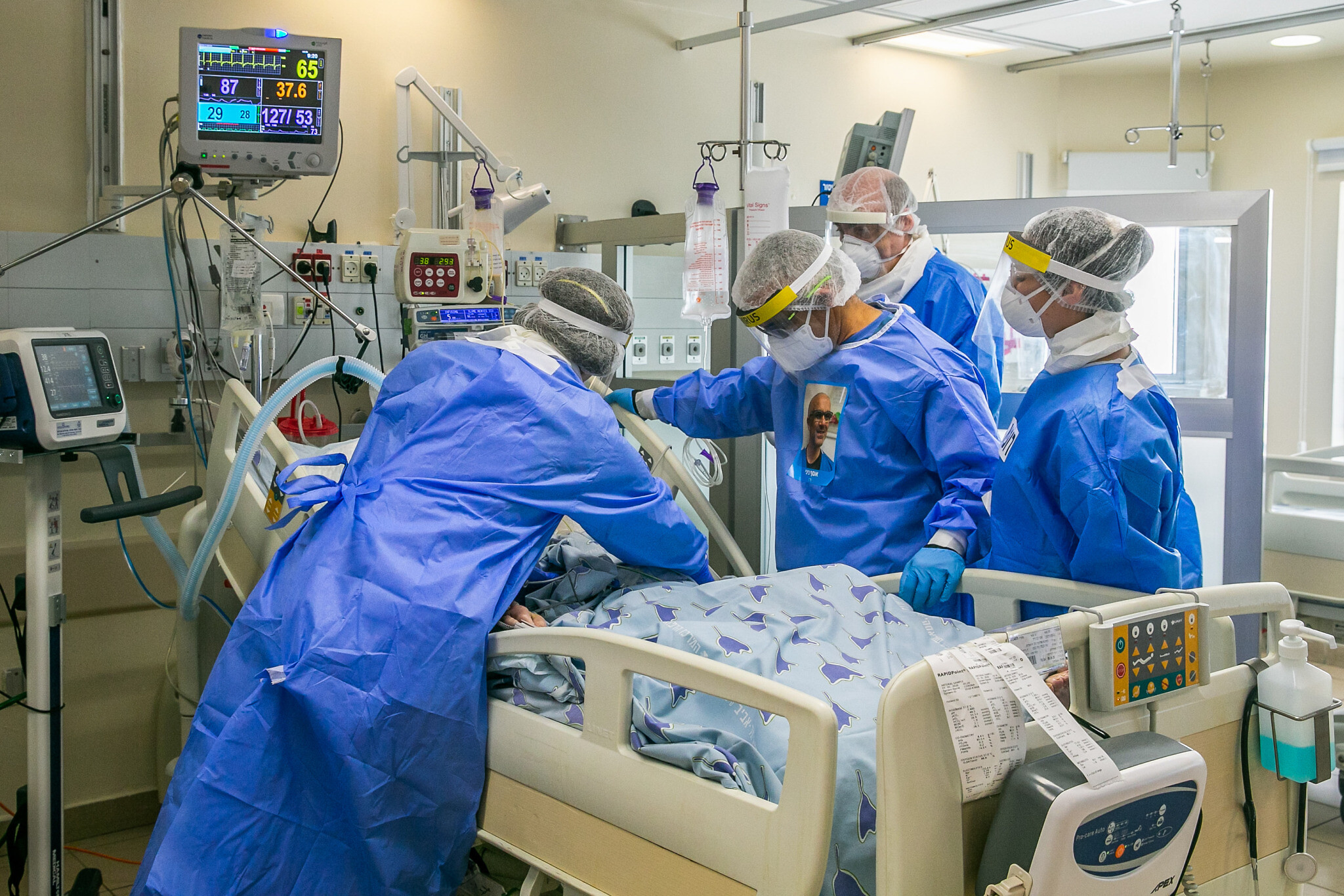
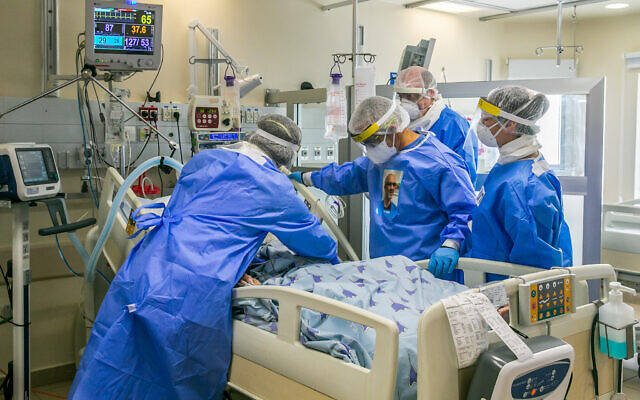
Doctors at Tel Aviv Sourasky Medical Center treat a patient in the coronavirus unit. May 4, 2020. (Yossi Aloni/Flash90)
With confusion around the world regarding how COVID-19 harms the
heart, an Israeli cardiologist says he has pieced together the clearest
picture to date.
The disease causes a unique pattern of damage on the right side of the heart, which occurs in two out of every five hospitalized patients, according to a team led by Dr. Yishay Szekely of the Tel Aviv Sourasky Medical Center.
“Nobody knew what actually happened to the heart, and we’re now saying that 40 percent of hospitalized patients suffer from dysfunction on the right side, and that it’s rarely harming the left,” Szekely told The Times of Israel.
“We’ve proved what actually happens in the heart, and this is the first step toward understanding the disease better in relation to the heart, and more effectively guiding future treatment,” he added. “I believe that this is a big step.”
 Szekely recently published his research in the American Heart
Association journal Circulation, and says that the 100-patient study is
the world’s first to systematically use cardiac imaging to show the
impact of coronavirus on the heart, rather than relying on laboratory
tests alone.
Szekely recently published his research in the American Heart
Association journal Circulation, and says that the 100-patient study is
the world’s first to systematically use cardiac imaging to show the
impact of coronavirus on the heart, rather than relying on laboratory
tests alone.
COVID-19 is thought to manifest itself mostly as a respiratory illness, but is known to commonly cause heart damage. Szekley said that he instituted heart imaging for many of his hospital’s coronavirus patients in order to get some clarity — and has been surprised by what he saw.
He expected to witness damage to the left side of the heart, based on early reports from China and Europe, but instead found that almost all cases of heart damage are in the right ventricle.
When viruses cause direct damage to the heart, they mostly affect the left side, said Szekley. He added that there may also be harm to the right side, but he has never encountered a virus that consistently caused damage to the right side alone.
 “It may be that if you ventilate patients at high pressures you cause
damage, so it could be caused by the treatment and not by the disease,”
he said. If true, this would vindicate some doctors who have claimed
that ventilation can sometimes be harmful.
“It may be that if you ventilate patients at high pressures you cause
damage, so it could be caused by the treatment and not by the disease,”
he said. If true, this would vindicate some doctors who have claimed
that ventilation can sometimes be harmful.
Szekely thinks the main importance of his work is that insights into how the disease affects the heart will help researchers, doctors and drug companies to develop treatments. But he said that even before such breakthroughs, his findings can help doctors with patient care.
Based on the research and on his current hypotheses for explaining his findings, Szekely believes doctors may want to start paying close attention to the right side of the heart throughout hospitalization.
The disease causes a unique pattern of damage on the right side of the heart, which occurs in two out of every five hospitalized patients, according to a team led by Dr. Yishay Szekely of the Tel Aviv Sourasky Medical Center.
“Nobody knew what actually happened to the heart, and we’re now saying that 40 percent of hospitalized patients suffer from dysfunction on the right side, and that it’s rarely harming the left,” Szekely told The Times of Israel.
“We’ve proved what actually happens in the heart, and this is the first step toward understanding the disease better in relation to the heart, and more effectively guiding future treatment,” he added. “I believe that this is a big step.”
Dr. Yishay Szekely, cardiologist at Tel Aviv’s Sourasky Medical Center (courtesy of Yishay Szekely)
COVID-19 is thought to manifest itself mostly as a respiratory illness, but is known to commonly cause heart damage. Szekley said that he instituted heart imaging for many of his hospital’s coronavirus patients in order to get some clarity — and has been surprised by what he saw.
He expected to witness damage to the left side of the heart, based on early reports from China and Europe, but instead found that almost all cases of heart damage are in the right ventricle.
When viruses cause direct damage to the heart, they mostly affect the left side, said Szekley. He added that there may also be harm to the right side, but he has never encountered a virus that consistently caused damage to the right side alone.
But as this seemed to be the
case with COVID-19 based on his study, he said, there were only two ways
of interpreting the results. One was to conclude that coronavirus has a
different effect on the heart than other viruses — Szekely dismissed
this as highly unlikely. The other possibility was to conclude that the
heart isn’t reacting directly to the virus, but rather to strain in the
lungs.
This
made sense, Szekely said, given that the right side of the heart is
tasked with pumping blood to the lungs. “Elevated pressure in the lungs
causes the right side of the heart to work harder,” he said. “Think of a
pump that needs to work harder because of more resistance.”
This finding should discourage
researchers from investing in directly addressing the impact of
coronavirus on the heart, and encourage them to consolidate their
efforts on finding ways of improving patient health in the lungs,
Szekely said.
He has several theories as to why the
disease is damaging the right side of the heart, some related to the
lungs’ reaction to the virus, and one hypothesis that suggests that
treatment could actually be agitating the lungs.
A doctor checks a medical ventilator
control panel at the Samson Assuta Ashdod University Hospital, on March
16, 2020 (Jack Guez/AFP)
Szekely thinks the main importance of his work is that insights into how the disease affects the heart will help researchers, doctors and drug companies to develop treatments. But he said that even before such breakthroughs, his findings can help doctors with patient care.
Based on the research and on his current hypotheses for explaining his findings, Szekely believes doctors may want to start paying close attention to the right side of the heart throughout hospitalization.
“The research can already start to help
guide treatment, for example [by] prompting use of blood thinners in
order to allow the right ventricle to work against lower pressure, and
adjusting ventilation parameters based to a greater degree on the state
of the patient’s heart,” he said.
Now, more than ever, is the time to support quality journalism
A message from the Editor
David Horovitz
Our team is covering the
coronavirus crisis in Israel and the Jewish world around the clock -
because we know how essential trustworthy information is to you right
now. If you appreciate the fast, fair and free journalism of Times of
Israel, then now is the time to support our work - and receive an AD-FREE experience.
A Civics Lesson From the Pandemic
As
America has struggled to respond to Covid-19, the virus has reminded
everyone of how disorganized the country’s patchwork, federalized system
of government can be. (As Fareed has written,
the “challenge of creating a national strategy” to confront the virus
in the US “is complicated by the reality that the true power in public
health lies with 2,684 state, local and tribal systems, each jealously
guarding its independence.”) But rather than any problem with the
system, Harvard political theorist Danielle Allen argues in a new Foreign Affairs essay, Covid-19 has exposed a lack of civic competence in America’s citizenry.
President Trump has failed to lead everyone in the right direction, Allen argues, but American citizens haven’t handled it well, either. When it came time to make complicated decisions about lockdown policies—to weigh the advice of health experts against that of economists on a localized, case-by-case basis—Americans did not congeal around the common purpose of solving the problem. A civic shortfall revealed itself well before the pandemic, after Trump’s election in 2016, Allen argues: “What astonished me was how few people knew where to start,” Allen writes writes of those disgruntled over Trump’s win. “They did not know how to call a meeting, how to engage their fellow Americans in a conversation about diagnosing their circumstances and finding some sort of shared purpose. All that constitutional democracy is, is a set of institutions that give people the chance to do these things and, if they do them well, to shape their communities. Yet Americans no longer understood how to use the machinery sitting all around them.” The civic deficit has been on display again during the pandemic, she writes.
So while the federal government may have failed a leadership test, Allen argues, Covid-19 has revealed a need for better civic awareness. “The federal government spends $54 per student per year on the STEM fields,” Allen notes, lamenting a decline in civics education in American high schools. “The figure for civics education: five cents.” It’s not America’s system of government that’s the problem, Allen argues; it’s that we’ve forgotten how to use it.
President Trump has failed to lead everyone in the right direction, Allen argues, but American citizens haven’t handled it well, either. When it came time to make complicated decisions about lockdown policies—to weigh the advice of health experts against that of economists on a localized, case-by-case basis—Americans did not congeal around the common purpose of solving the problem. A civic shortfall revealed itself well before the pandemic, after Trump’s election in 2016, Allen argues: “What astonished me was how few people knew where to start,” Allen writes writes of those disgruntled over Trump’s win. “They did not know how to call a meeting, how to engage their fellow Americans in a conversation about diagnosing their circumstances and finding some sort of shared purpose. All that constitutional democracy is, is a set of institutions that give people the chance to do these things and, if they do them well, to shape their communities. Yet Americans no longer understood how to use the machinery sitting all around them.” The civic deficit has been on display again during the pandemic, she writes.
So while the federal government may have failed a leadership test, Allen argues, Covid-19 has revealed a need for better civic awareness. “The federal government spends $54 per student per year on the STEM fields,” Allen notes, lamenting a decline in civics education in American high schools. “The figure for civics education: five cents.” It’s not America’s system of government that’s the problem, Allen argues; it’s that we’ve forgotten how to use it.
South Asia: The Next Region to Be Hit?
“Over
the past week Bangladesh, India and Pakistan have largely lifted
nationwide lockdowns intended to curb the spread of covid-19,” The Economist writes.
“The freeing of 1.7bn people—more than a fifth of humanity—from varied
restrictions will bring relief to the region’s battered economies.” But
along with that lifting has come a rise in cases, the magazine writes,
predicting South Asia could be the next world region to be hit hard by
the virus.
Troublingly, health systems are coming under strain: “Three medical interns at another hospital in the centre of Mumbai recently released a video claiming that they had been left for hours in sole charge of 35 seriously ill covid-19 patients, with no doctors, nursing or cleaning staff to help,” the magazine writes. “Doctors in Pakistan say the government’s claim that there are adequate hospital beds is nonsense.”
In India, the magazine writes, one can partly blame the policies of Prime Minister Narendra Modi’s government, as a sudden lockdown led migrant workers to rush home—just the kind of travel one wants to avoid encouraging during the pandemic. “The authorities first tried to block the movement, bottling migrants in urban slums with the highest infection rates, and then allowed perhaps 20m workers to leave, spreading the disease across the country,” the magazine writes. As Amy Kazmin wrote late last month for the Financial Times, India swiftly implemented the world’s largest lockdown—only to completely reverse it. As government data show, cases are now rising fast.
Troublingly, health systems are coming under strain: “Three medical interns at another hospital in the centre of Mumbai recently released a video claiming that they had been left for hours in sole charge of 35 seriously ill covid-19 patients, with no doctors, nursing or cleaning staff to help,” the magazine writes. “Doctors in Pakistan say the government’s claim that there are adequate hospital beds is nonsense.”
In India, the magazine writes, one can partly blame the policies of Prime Minister Narendra Modi’s government, as a sudden lockdown led migrant workers to rush home—just the kind of travel one wants to avoid encouraging during the pandemic. “The authorities first tried to block the movement, bottling migrants in urban slums with the highest infection rates, and then allowed perhaps 20m workers to leave, spreading the disease across the country,” the magazine writes. As Amy Kazmin wrote late last month for the Financial Times, India swiftly implemented the world’s largest lockdown—only to completely reverse it. As government data show, cases are now rising fast.
 |
|
 |
 |
Former WHO Chief Says Europe Acted Too Slowly
Former
Norwegian Prime Minister Gro Harlem Brundtland headed the World Health
Organization as its director-general from 1998 to 2003, a stretch that
included the SARS epidemic—and China’s lack of transparency surrounding it. In an interview with Der Spiegel this week, Brundtland defended
current WHO chief Tedros Adhanom Ghebreyesus’s much-criticized approach
to China amid Covid-19 ("his intention could have been to get China to
cooperate more closely”) and questioned whether the US will really exit
the WHO over it, as President Trump has promised: “the U.S. President is
not omnipotent—there is still Congress in Washington, after all,”
Brundtland said. “Besides, there will be an election in half a year.”
As for Europe’s handling of the pandemic, Brundtland said she “was a little surprised that the reactions were so slow all over Europe.” Information about Covid-19 may have developed slowly, but there were early signs that it was being transmitted between humans. “Europe made mistakes, too. Apparently, many of the people responsible were very optimistic about the efficiency of their healthcare system. And they obviously underestimated how contagious the new coronavirus is.”
And a future pandemic could be even worse than this one, Brundtland warned, arguing that air travel, in particular, needs new policies to keep deadly viruses from spreading around the world so quickly.
As for Europe’s handling of the pandemic, Brundtland said she “was a little surprised that the reactions were so slow all over Europe.” Information about Covid-19 may have developed slowly, but there were early signs that it was being transmitted between humans. “Europe made mistakes, too. Apparently, many of the people responsible were very optimistic about the efficiency of their healthcare system. And they obviously underestimated how contagious the new coronavirus is.”
And a future pandemic could be even worse than this one, Brundtland warned, arguing that air travel, in particular, needs new policies to keep deadly viruses from spreading around the world so quickly.
How Epidemiologists Are Feeling About All This
When
do you imagine you’ll feel safe attending a dinner party? Bringing in
mail without precautions? Getting a haircut? Traveling by airplane? The New York Times asked
these—the questions of our era—of 511 epidemiologists to gauge how
they’re personally approaching Covid-19 and the risk-avoidance
lifestyle.
The results were somewhat encouraging: 64% said they’d feel fine bringing in mail without precautions this summer; 60% would see a doctor for a nonurgent appointment before fall. Pluralities said it wouldn’t be until later in the next year, three to 12 months from now, that they’d feel safe doing things like eating in a restaurant, attending a dinner party, sending their kids to school, or going to the gym. Pluralities said they’d wait a year or more to attend a wedding or funeral, hug or shake hands when greeting a friend, or attend a religious service. Attending a sporting event, concert, or play ranked last among things they’d feel safe doing, with 64% saying they wouldn’t for a year or more.
For epidemiologists, as for the rest of us, it’s about tradeoffs between Covid-19 and other kinds of well-being, like mental health and children’s development at school, camp, or day-care, the Times’ Margot Sanger-Katz, Claire Cain Miller, and Quoctrung Bui note. Recent PhD Melissa Sharp “said she’d consider dating after a period of confinement,” they write. “‘I’m young and single, and a gal can only last so long in the modern world,’ she said. For Robert A. Smith of the American Cancer Society, a haircut might be worth the risk: ‘It really is a trade-off between risky behavior and seeing yourself in the mirror with a mullet.’”
The results were somewhat encouraging: 64% said they’d feel fine bringing in mail without precautions this summer; 60% would see a doctor for a nonurgent appointment before fall. Pluralities said it wouldn’t be until later in the next year, three to 12 months from now, that they’d feel safe doing things like eating in a restaurant, attending a dinner party, sending their kids to school, or going to the gym. Pluralities said they’d wait a year or more to attend a wedding or funeral, hug or shake hands when greeting a friend, or attend a religious service. Attending a sporting event, concert, or play ranked last among things they’d feel safe doing, with 64% saying they wouldn’t for a year or more.
For epidemiologists, as for the rest of us, it’s about tradeoffs between Covid-19 and other kinds of well-being, like mental health and children’s development at school, camp, or day-care, the Times’ Margot Sanger-Katz, Claire Cain Miller, and Quoctrung Bui note. Recent PhD Melissa Sharp “said she’d consider dating after a period of confinement,” they write. “‘I’m young and single, and a gal can only last so long in the modern world,’ she said. For Robert A. Smith of the American Cancer Society, a haircut might be worth the risk: ‘It really is a trade-off between risky behavior and seeing yourself in the mirror with a mullet.’”
 |
| CORONAVIRUS BRIEFING |
|
The last seven days may not have been as upsetting and
infuriating as the seven before them but, let’s be honest, that’s an
imposingly high bar to clear. As protests around the death of George
Floyd and other instances of police brutality continue in the United
States and abroad, coronavirus remains the background noise in every
conversation. Please don’t let your guard down too far. This week’s Haymarket Media Coronavirus Briefing is 1,059 words and will take you six minutes to read. |
|
|
| The news |
 |
| Getty Images |
| More and more states have thrown themselves open for haircuts and spray tans and medium-distance appetizers, which should provide a degree of relief for the millions of businesses gutted by the shutdowns of the last few months. Unfortunately, that relief comes with a price. |
|
| The Takeaway: |
| To quote a guy who knew his way around an aphorism: “The past is never dead. It’s not even past.” We’re getting ahead of ourselves and we know it. |
| Sponsored Content |
|
|
&cid=&e=5461259551b4a893fe0c287100d45c8f27d93dc212ee50c4fcc479f4fac225ef&c=proclivity_95487&pubid=202&siteid=20243&p=1) |
|
|
|
|
| The workplace |
 |
| Getty Images |
| Many of our peers say they’ve gotten used to the way we’re currently working – the Zoom calls, the child/pet/non-cute uninvited guest invasions and the leisurewear. But with so much of the workplace environment relegated to virtual purgatory, it’s easy to forget about the many, many things that have to happen for companies to function effectively. Some of those things are happening; many are not. |
|
| The Takeaway: |
| In conversations about the state of the workplace, “normal” has entered the realm of abstract concept. |
|
|
| The media |
 |
| Getty Images |
| Marketers and publishers seem genuine in wanting to wrestle with the myriad challenges confronting us all. Let the uncomfortable conversations continue. |
|
| The Takeaway: |
| Marketers and advertisers don’t have more or better answers than the rest of us, and that’s okay. Be suspicious of anyone who tells you otherwise. |
| Sponsored Content |
|
|
|
|
|
|
|
|
| The science |
 |
| Getty Images |
| With every week comes a bit more knowledge and understanding. There’s optimism around more than one of the potential vaccine candidates. A few of the expected infection super-spreaders – looking at you, Lake of the Ozarks merrymakers – haven’t materialized. Let’s quit while we’re ahead. |
|
| The Takeaway: |
| Yeah, there’s still more discouraging news on the medical/scientific front than encouraging news. Strike that intro paragraph, will you? |
|
|
| …and some songs |
| That’s it for this week’s edition of Haymarket Media’s Coronavirus Briefing. May you and yours continue to be safe and well. See you on the other side of the weekend. |
Subscribe to:
Posts (Atom)