Monday, July 20, 2020

Notable quotable

“Just before the patient died, they looked at their nurse and said ‘I think I made a mistake, I thought this was a hoax, but it’s not.’”
Physician Jane Appleby shares the last words of a person in their 30s who died after attending a ‘COVID-19 party’ to catch the virus on purpose. Appleby, a health official in San Antonio, Texas, hopes to raise awareness of the disease in the city, which has 18,000 reported cases. (WOAI News | 2 min read)
If We Get a Vaccine, the Politics Could Be Messy
Even if scientists find a vaccine, two Science articles argue it may not spell an easy end to Covid-19. For one, tricky ethical decisions lie ahead over who should be vaccinated first, Jon Cohen writes. “Nobody’s going to debate health care workers and first responders—people who are putting themselves at risk for others and keeping things moving,” former US National Vaccine Program Director Bruce Gellin, now of the Sabin Vaccine Institute, tells Cohen. “After that is when it gets complicated.”

Warren Cornwall expects anti-vaccine politics to get in the way, noting an online uptick. “In May, a documentary-style video, ‘Plandemic,’ purporting that COVID-19 related deaths were exaggerated and a vaccine could kill millions, got more than 7 million views on YouTube before it was removed because of its unsubstantiated claims,” he writes. “Other outlandish claims include that vitamin C can cure COVID-19 and that the disease is a conspiracy involving philanthropist Bill Gates.”

take drug testing out of the hands of manufacturers.

Corruption and the pharmaceutical industry

In their new book, child psychiatrist Jon Jureidini and philosopher Leemon McHenry dispute the assumption that all approved drugs and medical devices are safe and effective. They warn that when clinical science is hitched to the pharmaceutical industry’s dash for profits, the scientific method is undermined by marketing spin and cherry-picked data. Their proposed solution is inspired by philosopher of science Karl Popper: take drug testing out of the hands of manufacturers.
Nature | 6 min read

Notable quotable

“They literally gained nothing… it’s a self-inflicted wound, and they have no economic gains.”
Economic researcher Jacob Kirkegaard responds to numbers showing that Sweden’s light-touch lockdown approach to the pandemic has cost many lives without protecting its economy. (The New York Times | 9 min read)


Friday, July 3, 2020

Pharmas make billions on people's sufferings


image001


World

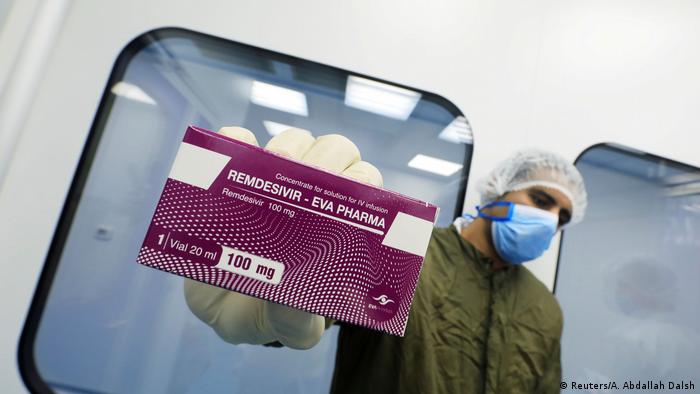
Coronavirus: Wealthy nations compete for remdesivir supplies

The world's wealthiest countries are competing for remdesivir, despite assurances that they would work together to develop drugs that treat COVID-19. Pharmaceuticals giant Gilead Sciences is in an enviable position.
Zolgensma, a gene therapy medicine for treating spinal muscular atrophy in children under the age of two, is now available in Germany. However, a single treatment of the drug, which is produced by Swiss pharmaceuticals company Novartis, comes at the steep price of €1.9 million ($2.1 million).
The manufacturer argues that this is a reasonable price considering that without it, it costs between €2.5 and 4 million to treat the degenerative disease over a lifetime.
Gilead Sciences, which has developed remdesivir, takes a similar line of argument, saying that the drug, which is viewed as a promising tool in the fight against COVID-19, could save costs in the long run.
In an open letter earlier this week, Daniel O'Day, chairman and CEO of Gilead Sciences, wrote: "Taking the example of the United States, earlier hospital discharge would result in hospital savings of approximately $12,000 per patient. Even just considering these immediate savings to the healthcare system alone, we can see the potential value that remdesivir provides."
"We have decided to price remdesivir well below this value," he continued. "To ensure broad and equitable access at a time of urgent global need, we have set a price for governments of developed countries of $390 per vial. Based on current treatment patterns, the vast majority of patients are expected to receive a 5-day treatment course using 6 vials of remdesivir, which equates to $2,340 per patient."
Read more: Remdesivir is no miracle cure
A box and vials of Zolgensma (picture-alliance/AP Photo/Novartis) A single treatment of Zolgensma, produced by Swiss pharmaceuticals firm Novartis, costs €1.9 million
What is fair drug pricing?
The editor of the German specialist magazine Arznei-Telegramm, Wolfgang Becker-Brüser, is not convinced. He told DW that the costs of treating COVID-19 without remdesivir had been calculated at random.
"There is an attempt to give the impression that the price is fair," he said. "However, if there wasn't a pandemic and so much public attention they might have set the price much higher."
The Association of Research-Based Pharmaceutical Companies (vfa) refused to comment. "The vfa does not comment on the pricing schemes of individual companies," it said in a statement to DW.
But in the past, the vfa has called on the pharmaceuticals sector to show responsibility with regard to consumers and demanded that affordable medicine and vaccines be made available.
An analysis by British researchers cited in the Germany weekly Der Spiegel came to the conclusion that it probably cost about €8 to produce one dose of remdesivir.
However, it is normal for the sale price to be much higher than the production price, considering companies invest huge sums into development.
Read more: How lab animals have fared in the coronavirus crisis
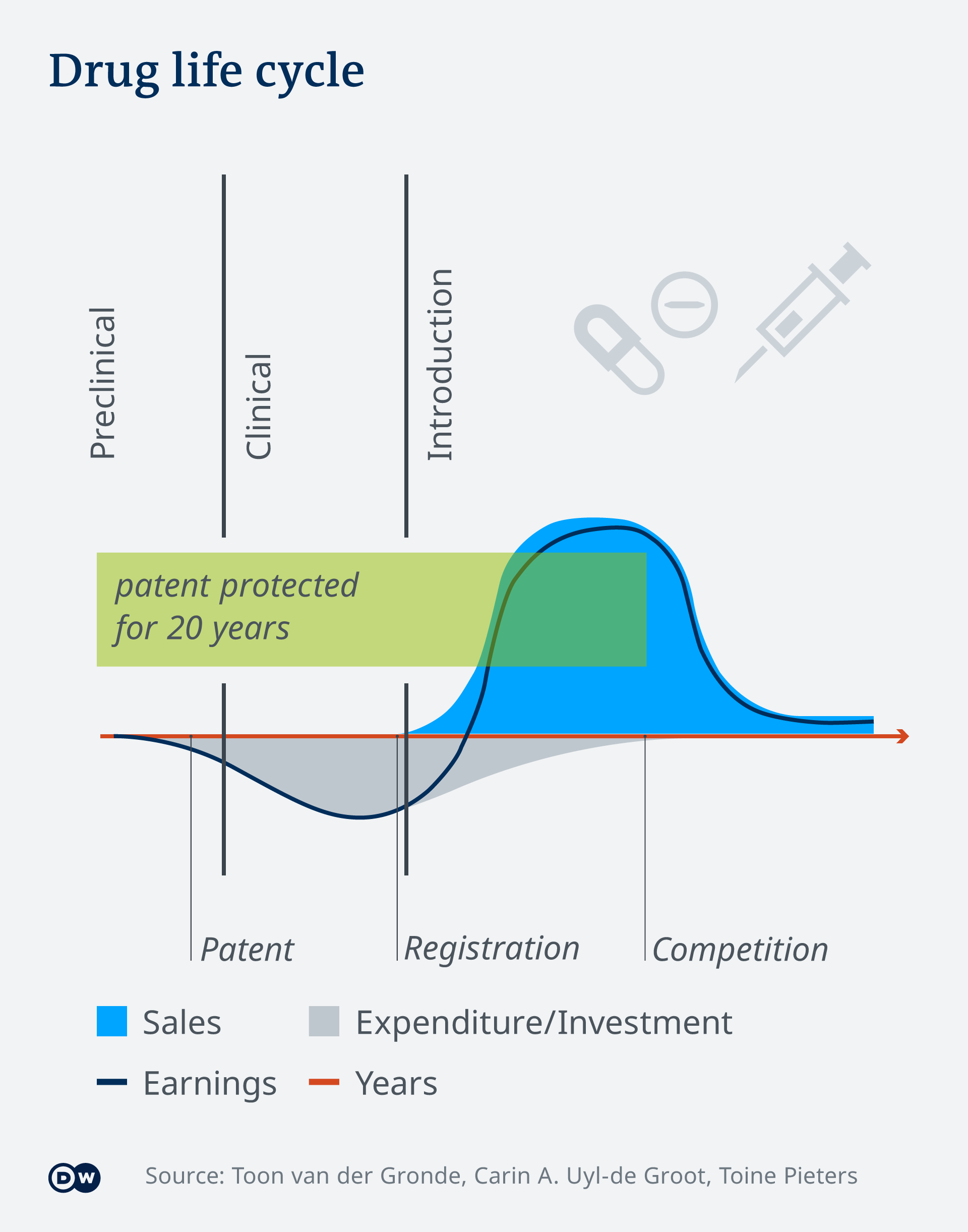
Graphic: Drug life cycle
Gilead Sciences claims that it invested about $1 billion into remdesivir. This is actually at the lower end of the vfa's scale for developing a new drug. The association told DW that companies tended to invest $1 to 1.6 billion in a new product.
For Wolfgang Becker-Brüser, this is "fantasy."
"If the development costs are calculated to be so high then it is easy to demand higher prices," he told DW.
For Alexander Nuyken, a pharmaceuticals expert at the consulting firm EY, there is a reason that development costs are so high: they encompass the risk of failure. "It has to be possible to add a premium for the risks incurred from the development of a drug to its approval," he said.
Watch video 03:16

What is Remdesivir?

Becker-Brüser said that in general drugs were becoming more expensive. "The number of prescriptions for new patented drugs is the same but their price is going up," he said. This was already the case before the COVID-19 pandemic, as indicated by a report by the German health insurance company AOK from last year, according to which insurance companies are paying an increasingly high proportion of their medicine budget on particularly expensive drugs. Drugs as pricey as Zolgensma are only the tip of the iceberg.
Read more: Is the US-China rivalry tangling a coronavirus vaccine with geopolitics?
With regard to remdesivir, however, there had been some expectation that the cost per course of treatment would actually be higher. The Institute for Clinical and Economic Review, a US-based nonprofit organization that analyzes drug prices, had suggested that a reasonable price would be $2,800, while others had recommended $4,000.
But considering that remdesivir is practically a waste product, which Gilead Sciences originally developed to treat Ebola, without major success, Becker-Brüser presumes that the company opted for a compromise in view of the public pressure.
It could turn out to be a win-win situation for the company. Its share price rose when the price of remdesivir was announced earlier this week and orders have gone through the roof.
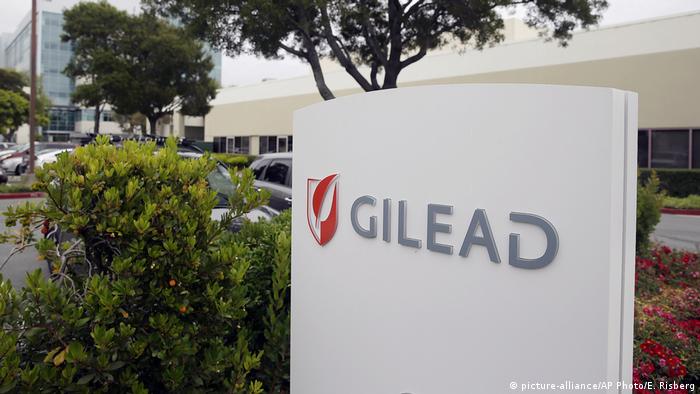
Gilead Sciences building (picture-alliance/AP Photo/E. Risberg) After being ineffective against Ebola, Gilead Sciences drug remdesivir is getting a second chance against COVID-19
Global competition
According to media reports, the US has already secured the entire stock of projected production for July and 90% for August.
Germany, too, has apparently secured supplies. Health Minister Jens Spahn has been applying pressure. He said that he expected "Germany and Europe to have access to supplies to such a drug." The British government has also said that it has enough reserves.
So far, remdesivir has not been fully approved in any country and there has not been enough research into how effective it really is against the novel coronavirus. But apart from Dexamethason, it is the drug that seems to have the most potential for treating patients with SARS-CoV-2 and limiting the disease's course.
Read more: Is dexamethasone the game changer in COVID-19 treatment?
Alexander Nuyken said that it was not surprising that the world's wealthy nations were all eager to get hold of supplies. "That's why it is particularly important that we find common solutions in international alliances."
There are already several international forums in which this is being attempted and a European vaccine alliance has been formed with the WHO.
However, the problem, as with the global fight against the climate emergency, is that if the US does not play by the same rules, the attempts of other states will be curbed.
Those who benefit, said Becker-Brüser, are the pharmaceuticals giants, "which are in a position to aim higher."
It will soon become clear how high Gilead Sciences is prepared to go. Right now, the European Union is negotiating with the US company and trying to ensure that all 27 states have supplies in the coming months.


red dead redemption 2 review